
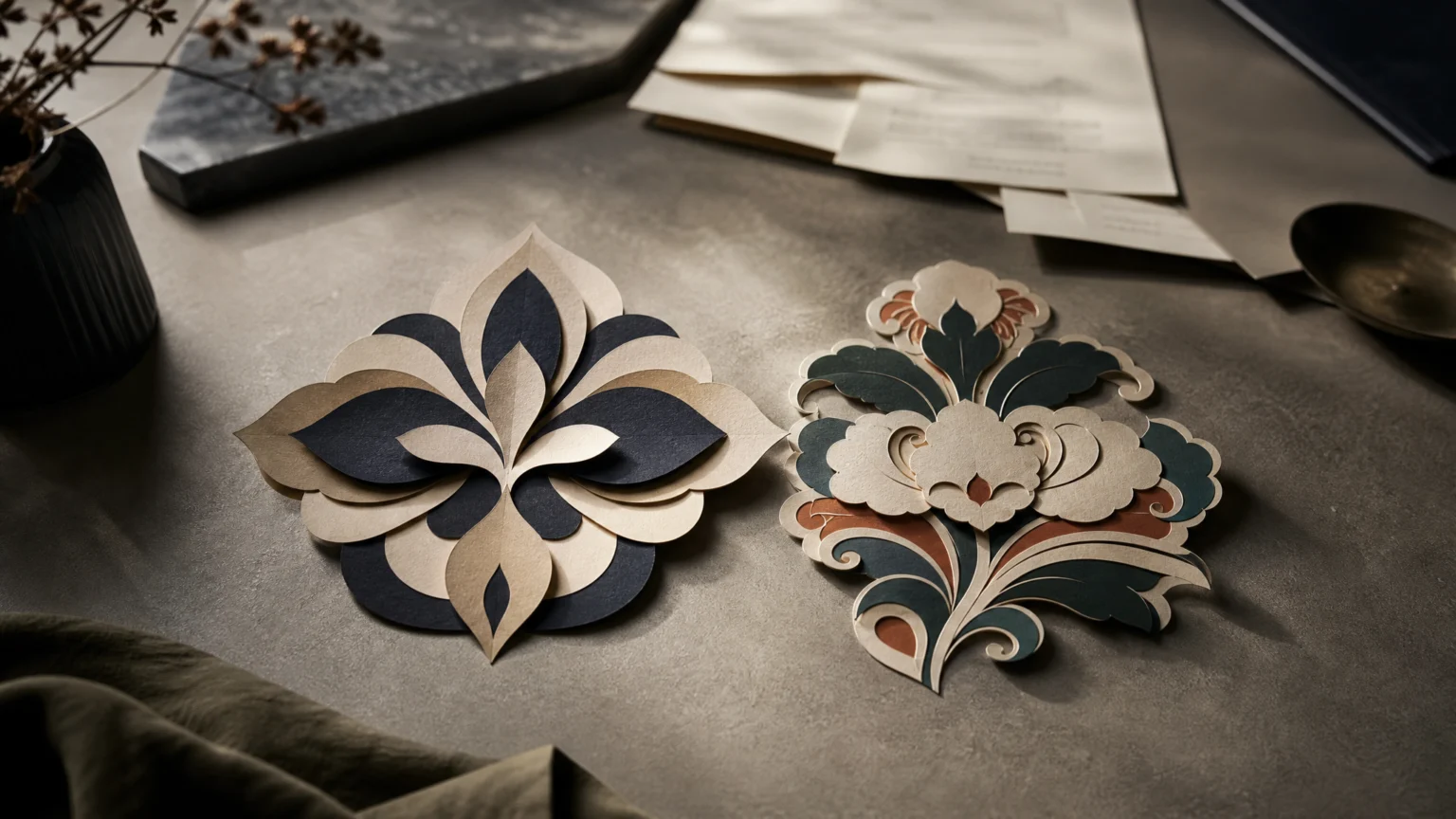
A four-petal flower seems small until two audiences read it in two different ways. In China, that split sat at the center of a trademark fight that grew into a wider argument about culture, ownership, and who gets to define resemblance.
Louis Vuitton faced public backlash in China after a trademark dispute involving local tea maker Molly Tea. The case focused on Molly Tea’s four-petal floral design, which was found too similar to Louis Vuitton’s monogram. Louis Vuitton won the case, but the decision did not settle the visual question in the public mind.
People defended Molly Tea and argued that its mark looked less like a luxury monogram and more like a traditional Chinese motif, specifically a Tang Dynasty baoxiang flower pattern. Once a symbol carries two readings at once, legal clarity and cultural clarity can start moving in different directions.
Form alone does not settle resemblance

From a distance, design disputes can look technical. Petal count, outline, spacing, and proportion all invite side-by-side comparison. But a mark takes meaning from context as much as geometry.
That is why this case reaches beyond one verdict. A floral emblem can sit inside brand memory for one audience and inside shared visual heritage for another. When those claims overlap, the issue is not just form. It becomes a question of authorship and public permission.
A related tension appears in when branding language becomes the dispute, where the contested asset is the framing around the design as much as the design itself.
Backlash changed the business result
The backlash had visible commercial force. A research firm observed double-digit sales declines in August, after an approximately 30% decline in July narrowed to an estimated 20% to 25%. At that point, the dispute was no longer only a trademark case. It had become a brand-performance problem.
This is the uncomfortable part for design and brand teams. A company can protect its intellectual property and still lose ground if the public reads the move as overreach. The courtroom may decide ownership, but customers decide tone, timing, and consequence.
Intellectual property is a key asset, and brands protect it diligently. The harder task is protecting it without making the audience feel that familiar cultural forms are being enclosed.
That is where social listening before launch starts to look less like a marketing add-on and more like part of brand governance. Once sentiment hardens, every later message has to work against an established narrative.
Silence carried its own message

At the peak of the controversy, Louis Vuitton’s social media accounts on Chinese platforms including Douyin, Weibo, and Xiaohongshu fell silent. That absence became its own signal. In moments of pressure, people read pauses as carefully as posts.
Executive attention followed. Louis Vuitton CEO Pietro Beccari and Deputy CEO Damien Bertrand traveled to China to assess the situation. When senior leadership steps in, it usually means the issue has moved beyond legal process and into brand stewardship.
From a communications design perspective, that shift matters. A logo dispute may begin with static shapes, but the response unfolds across channels, timing, and visible presence. Brand behavior becomes part of the visual system because audiences experience the whole performance, not just the mark.
Cultural claims can outrun legal claims
The controversy grew into a wider debate about cultural ownership and foreign-brand risk in China. That expansion makes sense. Symbols with long decorative histories rarely stay contained inside legal categories once the public starts recognizing them as shared forms.
For global brands, the challenge is practical. The stronger a company is at defending its signature, the more carefully it has to study local visual history before drawing hard boundaries. If a protected motif appears close to a longstanding cultural pattern, enforcement can read less like discipline and more like appropriation in reverse.
That does not mean brands should stop defending trademarks. It means the threshold for action should include more than visual comparison charts. Teams need cultural review, regional sensitivity, and a realistic read on how an audience will narrate the dispute once it leaves legal documents and enters public feeds.
Review the symbol before enforcing the boundary
Cases like this suggest a better internal checklist for identity teams. Before escalation, ask what a local audience sees first: a competitor borrowing equity, or a familiar pattern being fenced off. Those are different stories, and each one creates different downstream risk.
- Map the motif’s history. If the form resembles a known decorative tradition, document that early.
- Test local interpretation. Regional review can reveal whether a mark reads as proprietary, generic, or culturally rooted.
- Assess communication fallout. A legal win may still damage trust if the public story turns patriotic or protective.
- Prepare visible responses. Silence has meaning, so channel strategy should be planned before controversy peaks.
This kind of review is less about hesitation than direction. It helps brands distinguish between a copy problem and a context problem, which are rarely solved the same way.
A small mark sent a larger signal
A floral emblem triggered the dispute, but the larger message came from the reaction around it. In China, the case exposed how quickly a trademark question can become a referendum on cultural respect, foreign-brand judgment, and audience loyalty.
For designers, the practical lesson is straightforward. Distinctive marks do not live by shape alone. They live in history, in local recognition, and in the public stories that gather around them once conflict begins.
 Icon Template
 Photo Template
 Photo Template
 Logo Template