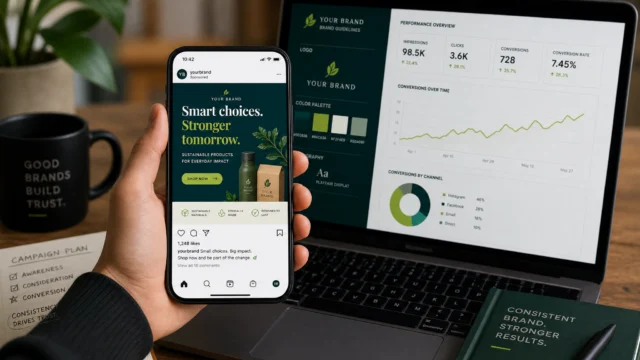

Access is often the part of branding that gets missed. A small business can know it needs clearer visuals, better social posts, and sharper proposals, then stall on budget, software, or the simple fact that nobody on the team is a trained designer.
That is why the partnership between Canva Africa and Paystack stands out. It gives Nigerian entrepreneurs access to AI-powered creative tools, with six months of Canva Business at no cost for eligible merchants through the Paystack Small Business Bundle.
At first glance, that reads like a software perk. In practice, it speaks to a deeper design problem: many small businesses do not struggle because they lack ideas. They struggle because brand materials are hard to make consistently, expensive to outsource, or too scattered to manage well.
Free access matters when the real constraint is repetition
Small-business design is rarely one big reveal. It is the repeated work of making a flyer, resizing a post, updating an offer card, preparing a proposal, and keeping every customer-facing surface recognizable from one week to the next.
Six months of Canva Business at no cost gives eligible merchants time to build those habits without adding another monthly decision. A short trial can encourage experimentation, but half a year gives a business more room to establish a workable rhythm around templates, approvals, and recurring content.
For owners managing tight budgets, the value is not just that the tool is available. Access comes through a bundle connected to a platform that serves more than 200,000 active merchants in Nigeria, giving the initiative potentially broad reach across a growing small-business ecosystem.
Brand management does the quiet heavy lifting

The package includes Canva Pro, brand management features, and professional content creation tools. That middle piece deserves more attention than it usually gets.
Brand management features help a business keep its colors, fonts, logos, and other recurring choices in one place. For a small team, that can reduce the drift that appears when each new post or proposal is built from scratch by a different person, on a different day.
Consistency is not a cosmetic extra. It supports recognition. A business starts to look more settled when its sales deck, social graphic, and promotional material feel related, even when they are made quickly.
AI tools are most useful when the work is broad
AI-powered creative tools are easy to discuss in abstract terms, but the useful cases here are concrete. Nigerian entrepreneurs in this initiative can use the tools to produce marketing materials, social media content, business proposals, and advertising assets more efficiently.
That list covers very different business moments. Social media content keeps a brand visible. Marketing materials support everyday promotion. Business proposals help a company present itself in more formal settings. Advertising assets demand speed, iteration, and clear direction.
For many small businesses, all of that sits on the same desk. One person may be handling sales, customer service, inventory, and communications at once. A toolset that shortens production time across several formats can shape the difference between a brand that appears only when there is spare time and one that shows up regularly enough to be remembered.
Regular output does not guarantee strong design. It does, however, create the conditions where better decisions can hold, because the business is working from reusable parts instead of starting cold every time.
The initiative addresses three missing resources at once
The barriers this partnership addresses are straightforward: limited budgets, lack of specialist design skills, and restricted access to advanced creative tools. Those problems tend to compound each other.
When budget is tight, a business postpones design help. When specialist skills are missing, the team improvises. When advanced tools are out of reach, even capable ideas can end up looking unfinished.
This is where practical design infrastructure matters more than polished language. If a merchant can open one workspace, find brand elements already organized, and turn them into usable assets for multiple channels, the business spends less energy wrestling with production and more energy deciding what it wants to say.
That shift is small, but it matters. Good branding often begins when the mechanics stop getting in the way.
Broad reach changes the meaning of a design-tool offer

Paystack currently serves more than 200,000 active merchants in Nigeria. That scale changes how this partnership should be understood.
Many design-access programs stay niche because they reach only a thin slice of businesses already close to creative networks. A distribution path through a payments platform brings the offer closer to day-to-day commerce. It meets merchants where transactions already happen, rather than asking them to search for design support as a separate project.
That makes the offer feel more operational than symbolic. It places creative production alongside payment collection and digital presence, instead of treating design like a final decorative layer.
What Nigerian entrepreneurs can actually do with an offer like this
The most valuable use of a package like this is usually not making more graphics. It is building a smaller, steadier set of branded assets that can be reused without friction.
- Create a base library of recurring templates for promotions, announcements, and product highlights.
- Standardize proposal materials so sales conversations look more credible and less improvised.
- Unify advertising assets across formats instead of rebuilding every campaign from zero.
- Organize brand elements so anyone on the team can work faster without weakening the visual signature.
These are ordinary tasks, but ordinary tasks are where most brands become visible. What customers experience is usually a stack of repeated encounters, not a single memorable campaign.
Why this partnership deserves attention from designers too
Designers sometimes look at broad-access platforms and focus on what they simplify. The more useful question is what they make possible for businesses that had little formal design capacity in the first place.
If more Nigerian entrepreneurs can reach professional content creation tools, manage brand assets, and produce materials more efficiently, the visual baseline for small-business communication can improve. That does not erase the need for specialists. It often clarifies where specialist input matters most: identity systems, sharper messaging, stronger templates, and clearer hierarchies that small teams can carry forward themselves.
Good tools do not replace design thinking. They extend it into places where time, money, and access once kept it out.
 Photo Template
 Logo Template
 Icon Template
 Logo Template