When Automation Meets Brand Consistency in Video
Many video creators face a common dilemma: how to leverage AI for faster production without sacrificing the unique visual and auditory identity of their brand. Automated tools promise efficiency, but the real challenge lies in ensuring that AI-generated or AI-edited content aligns perfectly with established brand guidelines. A video that saves hours but feels off-brand can do more harm than good, eroding trust and recognition. This comparison examines two prominent AI video editing tools, Descript and Runway, focusing on how they automate tasks while allowing creators to maintain control over their final output.
Consider a marketing team needing to produce a dozen short social media clips from a single long-form interview. Manually editing each clip for length, filler words, captions, and consistent branding is time-consuming. An AI tool that can automatically transcribe, identify key moments, remove awkward pauses, and apply brand-approved visual styles would be invaluable, provided it doesn’t introduce generic aesthetics or require extensive manual correction afterward.
Transcript-Based Editing and Timeline Automation

The foundation of efficient AI video editing often starts with how the tool handles raw footage and transforms it into an editable format. A key differentiator is the ability to edit video through text, which can dramatically speed up the initial cutting process.
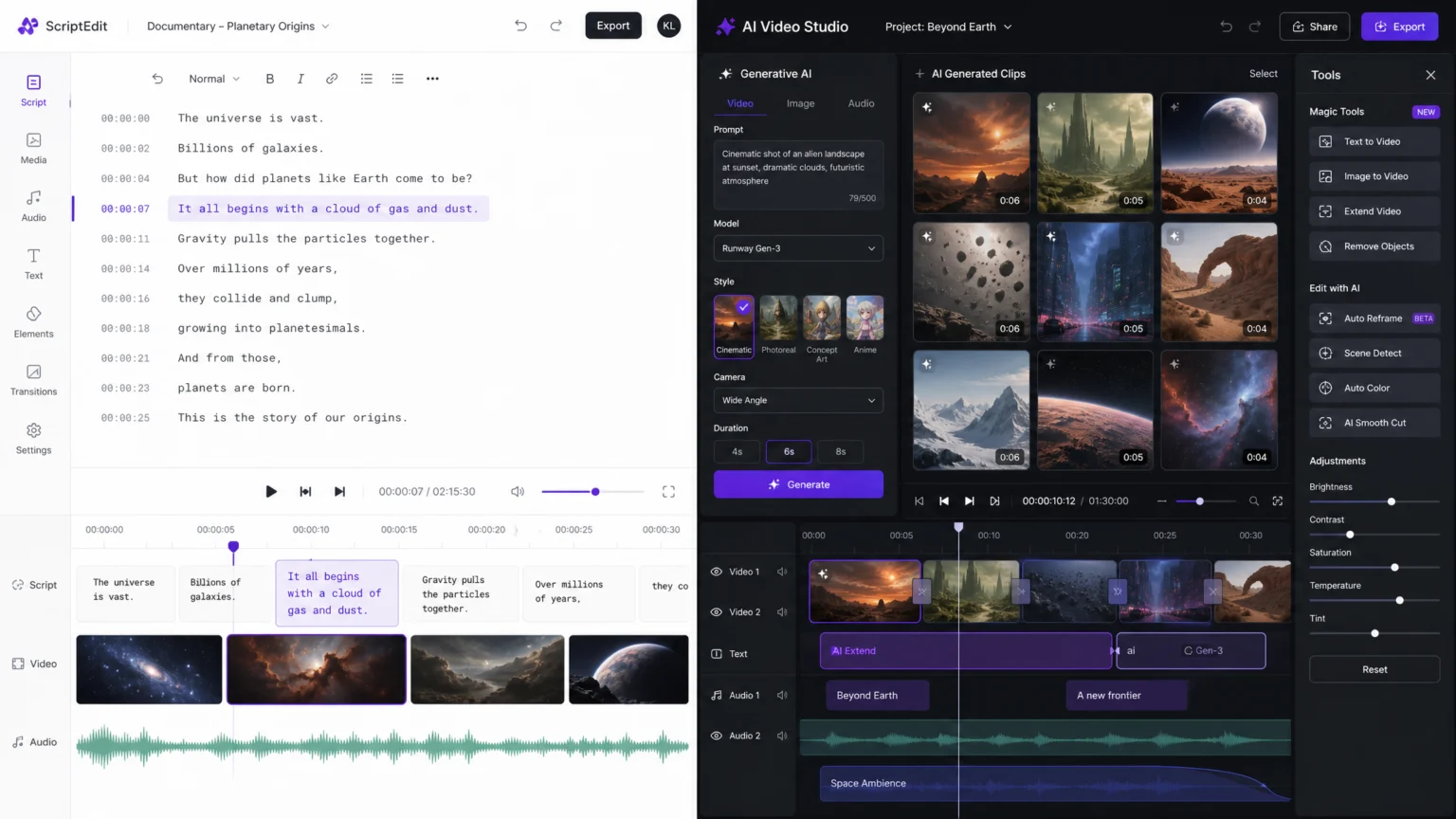
Descript excels in this area by allowing users to edit video by editing text. Its automatic transcription feature means that any changes made to the transcript instantly update the video timeline. This approach simplifies tasks like removing tangents or tightening dialogue, as editors can simply delete words or sentences in the text document, and the corresponding video segments disappear. Descript’s AI co-editor, Underlord, further automates this by tightening cuts and removing silences or filler words, which can be a significant time-saver for podcasts or interview-style content.
Runway approaches automation more from a generative standpoint, focusing on creating video content from scratch or transforming existing footage using AI models. While it offers powerful AI generation, its primary interface for editing is not built around text-based transcription in the same way Descript is. This means that for tasks requiring precise, word-by-word editing of spoken content, the workflow might involve more traditional timeline manipulation after initial generation.
For example, imagine a corporate training video where a speaker frequently uses “um” or “ah.” With Descript, an editor can quickly scan the transcript for these filler words and remove them with a few clicks, instantly cleaning up the audio and video. In contrast, a generative tool might require more manual intervention to achieve the same level of conversational polish if the initial script or prompt didn’t account for such nuances.
Descript: Best for transcript-led automation, especially for content with spoken dialogue.
Runway: Best for AI generation and automated video creation workflows, with less emphasis on text-based editing of existing dialogue.
AI Generation and Regeneration Capabilities
Beyond editing existing footage, AI tools are increasingly capable of generating entirely new video segments or transforming visuals based on prompts. This capability can be a game-changer for content creators looking to expand their visual library or create unique effects.
Descript offers an AI Video Maker that can turn a prompt, script, or existing footage into an editable video. This includes generating a script, voiceover, and visuals, with an optional avatar. This feature is particularly useful for quickly drafting explainer videos, social media snippets, or even initial storyboards. The output is editable, allowing for fine-tuning to match specific brand requirements.
Runway is known for its advanced AI image and video generation capabilities. Its platform allows users to create new visuals from text prompts, images, or even existing video clips. Runway’s focus is on pushing the boundaries of what AI can generate, making it a powerful tool for experimental visuals, stylized effects, or creating unique stock footage. Its pricing model is credit-based, with credits spent on models, Recipes, or Workflows at model-specific rates, indicating a focus on diverse generative tasks.
Consider a scenario where a brand needs a short, abstract visual sequence for a product launch announcement. Runway could generate several unique, stylized options from a text prompt, offering a range of creative directions. Descript’s AI Video Maker, while capable of generating visuals, might be more suited to producing a structured video with a clear narrative and voiceover, rather than purely abstract visual experimentation.
Descript: Best for generating structured videos with scripts, voiceovers, and visuals from prompts or existing content.
Runway: Best for advanced AI-powered video generation and transformation, ideal for creative visual effects and unique content creation.
Brand and Style Control for Consistent Output

Maintaining a consistent brand identity across all video content is crucial. This involves not only visual elements like logos, colors, and fonts but also the overall tone, pacing, and audio quality. AI tools must offer mechanisms to integrate these brand elements effectively.
Descript, through its editable script and visual timeline, allows for direct control over the narrative and presentation. While the evidence doesn’t detail explicit brand guideline integration features, the ability to add visuals and captions means users can manually apply brand assets. The AI co-editor can improve audio, which contributes to overall production quality, a key aspect of brand professionalism. The editable nature of the AI Video Maker output also means that creators can adjust generated content to fit their brand’s specific aesthetic.
Runway’s strength lies in its generative capabilities, which can be both an advantage and a challenge for brand consistency. While it can produce highly stylized visuals, ensuring these align perfectly with an existing brand guide requires careful prompting and potentially post-generation refinement. The platform’s focus on diverse AI models and workflows suggests that users have control over the style of generation, but integrating specific brand assets like custom fonts or color palettes might require additional steps.
For a brand with strict visual guidelines, Descript’s approach of editing existing or generated content offers a more direct path to ensuring adherence. A designer could, for instance, upload brand-approved lower thirds and easily integrate them into a Descript-edited video. With Runway, the emphasis would be on crafting prompts that guide the AI to generate visuals that align as closely as possible with the brand’s aesthetic, followed by manual adjustments if needed.
Descript: Offers direct editorial control over generated and edited content, supporting manual integration of brand assets and audio refinement.
Runway: Provides powerful generative capabilities that require careful prompting to align with brand aesthetics; post-generation refinement may be needed for strict adherence.
Audio Cleanup, Captions, and Repurposing Helpers
Beyond the core video editing, many AI tools offer supplementary features that streamline the entire content production workflow, from improving audio quality to preparing content for various platforms.
Descript’s AI tools are comprehensive in this regard. They can clean up audio, cut filler words and repeats, and automatically generate captions. This is particularly valuable for accessibility and for optimizing videos for social media platforms where many users watch without sound. Furthermore, Descript can draft show notes and social posts, and repurpose or publish content, making it an end-to-end solution for content creators who need to distribute their videos across multiple channels efficiently. This suite of features helps maintain consistency not just in the video itself, but in the accompanying text and metadata.
Runway’s primary focus is on the visual generation and transformation aspects of video. While it offers powerful tools for creating unique visual content, the evidence does not highlight extensive features for audio cleanup, automatic captioning, or content repurposing in the same integrated way as Descript. Users might need to export their generated video from Runway and use other tools for these post-production tasks.
Imagine a content creator publishing a tutorial video. Descript can not only edit the video and clean up the narration but also automatically generate accurate captions for accessibility and draft a summary for a blog post, along with social media snippets. This integrated workflow significantly reduces the manual effort required for post-production and distribution. For a creator using Runway, the primary benefit would be the ability to generate unique visual elements for the tutorial, but the subsequent steps for audio refinement and text generation would likely occur in separate applications.
Descript: Provides an integrated suite of AI tools for audio cleanup, automatic captions, and content repurposing, streamlining the entire publishing workflow.
Runway: Focuses on advanced visual generation; users may need external tools for comprehensive audio and repurposing tasks.
Workflow Simplicity for Editing and Publishing

The true value of AI in video editing often comes down to how seamlessly it integrates into a creator’s existing workflow and how straightforward it makes the entire process from raw footage to final publication.
Descript aims for a highly intuitive and integrated workflow. The text-based editing paradigm is often cited as a significant simplification, allowing users to approach video editing much like document editing. The presence of an AI co-editor and AI Video Maker, coupled with tools for audio cleanup, captions, and content repurposing, means that many stages of video production can occur within a single platform. This reduces the need to switch between multiple applications, saving time and reducing friction in the creative process. Descript also offers a free plan and paid plans starting at $12/month, making it accessible for various users.
Runway offers a powerful set of generative AI tools that can be integrated into creative workflows, particularly for those focused on visual innovation. Its credit-based pricing model reflects the computational intensity of its generative features. While Runway simplifies the creation of complex visual effects and new video segments, the overall workflow for a complete video project—from initial edit to final publication with all accompanying assets—might involve more steps and external tools compared to Descript’s more integrated approach. Runway’s pricing also starts at $12/month, with usage-based credits for AI features.
For a small team producing regular video content, Descript’s all-in-one approach can simplify the entire pipeline, from recording to publishing. The learning curve for text-based editing is often lower than traditional timeline editing, making it accessible to a wider range of content creators. Runway, on the other hand, is ideal for visual artists, filmmakers, or marketing teams looking to push creative boundaries with AI-generated visuals, often as part of a larger, more complex production workflow involving other editing software.
Descript: Offers a streamlined, integrated workflow for end-to-end video production, emphasizing ease of use and text-based editing.
Runway: Provides powerful generative AI tools best suited for visual innovation, potentially requiring integration with other software for a complete production pipeline.
Choosing the Right AI Video Editor for Your Brand

When selecting an AI video editor, the decision hinges on whether your priority is streamlined, text-driven automation for dialogue-heavy content or advanced generative AI for unique visual creation. Descript offers a comprehensive, integrated solution that simplifies the entire video production workflow, from transcription and editing to audio cleanup and content repurposing, all while providing direct control over the narrative. This makes it a strong choice for brands and creators who prioritize efficiency and consistent output across various content types, especially those with significant spoken elements. Understanding how AI video editing works can further inform this choice.
Runway, conversely, excels in its cutting-edge generative AI capabilities, allowing users to create novel visual content and effects from prompts. It’s an invaluable tool for those pushing creative boundaries and exploring new visual aesthetics, though it may require more manual integration with other tools for a complete, brand-consistent production pipeline. If your brand’s video strategy leans heavily into unique visual storytelling and experimental effects, Runway offers unparalleled generative power. Evaluate your typical video projects: if they involve extensive dialogue and repurposing, Descript’s integrated text-based editing might be more efficient. If visual innovation and AI-generated footage are central, Runway offers a robust platform for creative exploration.
 Icon Template
 Photo Template
 Icon Template
 Icon Template