A small budget shows every decision. When a campaign still feels sharp and memorable, the difference is usually not scale. It is a clearer idea, tighter choices, and a team that knows how to use what is already in the room.
One recent in-house campaign makes that easy to see. The team shot the ad in less than four hours, handled post-production internally, and moved from shoot to launch in roughly a month. That compressed timing matters because it shows how much visual impact can come from a compact process when the concept is settled early.
Start with a collision, not a blank page

The campaign did not begin by chasing polish. It began by combining a product scenario with a cultural reference the team saw spreading across the internet: 1990s and early 2000s nostalgia.
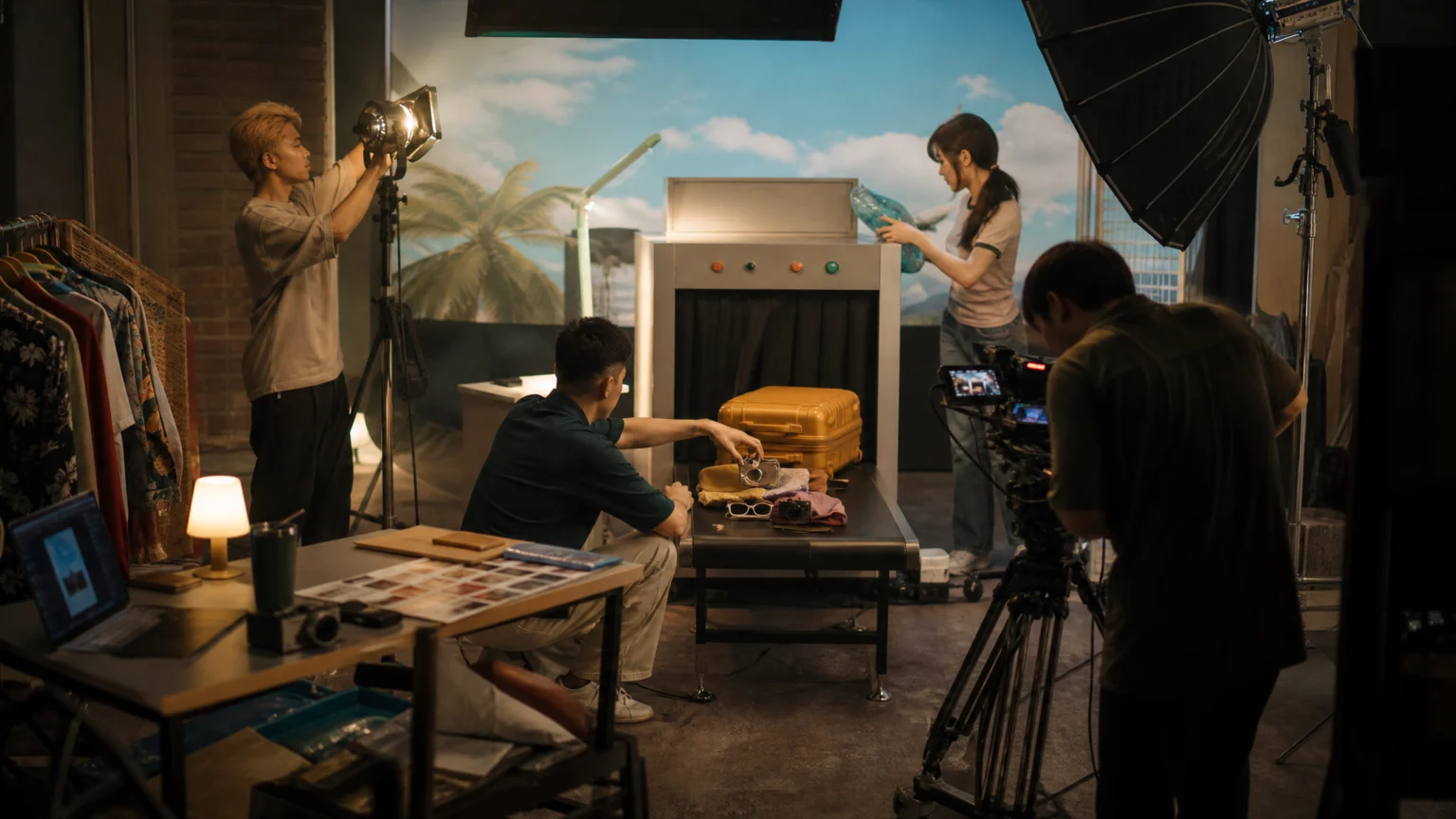
That mix led to an ad built around a TSA agent, a suitcase scanner, and a depuffing wand, followed by a dramatic transformation inspired by Sailor Moon. The concept works because it gives the product a setting, a character, and a shift in tone. Instead of listing benefits, it lets recognition carry part of the message.
For small brands, this is a practical creative pattern. You do not need to invent a whole new universe. You often need two familiar elements that create friction together: a product in an unexpected setting, or a practical use case paired with a pop-cultural mood. That is often where a visual signature begins.
Teams shaping social content may notice a similar pattern in how fan-first social media changes brand design from the inside. When audiences already recognize the energy around a format or reference, design can move faster without feeling careless.
Borrow context before you buy production

The most useful detail here may be the production setup. The company did not book an airport set specifically for the campaign. It was already shooting other travel-related content for another product that day, so the team piggybacked on that setup and filmed the commercial at the same time.
That kind of choice deserves more attention than it usually gets. Existing locations, props, lighting plans, and crew availability are not just ways to save money. They are design materials. They give a campaign texture that would be expensive to build from scratch.
Small brands can use the same logic almost anywhere. If a founder is already filming product demos, capture one extra idea with a different tone. If a retailer is refreshing seasonal photography, test a short narrative concept on the same set. If a team has one strong environment, use it twice with different framing and timing rather than spreading money across weaker scenes.
That approach also protects quality. Reusing a setup can free budget for the details viewers actually notice: styling, performance, editing, or one precise visual twist.
Speed helps when the idea already carries the weight
Shooting in less than four hours sounds impressive, but speed alone is not the lesson. Fast production works when the concept has enough structure to survive compressed execution.
Here, the ad had a clear sequence: discovery, trial, transformation. That built-in direction gave the team a straightforward path from storyboard to edit. A concise narrative like that reduces waste because each shot has a job.
Small brands often assume they need more footage to make a campaign feel stronger. Usually they need fewer shots with clearer purpose. A product close-up, a reaction, and a moment of change can carry more force than a long list of generic scenes.
This is one reason concise visual systems often outperform overloaded ones. The same principle appears in when three logo options feel like one: if the core idea is not distinct enough, extra variation does not add clarity. It only hides uncertainty.
Keep post-production close to the concept

The team handled post-production internally. That matters for more than efficiency. When the same group carries the work from concept through edit, the finished campaign is less likely to lose its tone halfway through the process.
Designers know this problem well. The handoff is often where a playful idea turns stiff, or where a strange little detail that made the concept memorable gets smoothed away. Internal post can preserve the intended rhythm because the people shaping the final frames understand which moments are structural and which are decorative.
This does not mean every small brand needs a full internal production bench. It means someone close to the idea should stay close to the final cut. If editing happens elsewhere, the creative brief needs to be concrete enough to protect the campaign’s personality.
Define approvals before anyone starts making brave work
There is another practical lesson here, and it has nothing to do with cameras. Creative ambition is much easier to execute when teams know who needs to approve what, when brand principles are clear, and when the acceptable level of risk has already been decided.
That may sound procedural, but it is also a design issue. Unclear approvals flatten ideas. They add hesitation, produce safer drafts, and invite late changes that weaken the original concept.
Small brands have an advantage here if they use it well. With fewer stakeholders, they can build shorter approval paths and give internal teams a more confident range to work within. A simple list of non-negotiables often helps more than an oversized brand manual: what must stay consistent, what can stretch, and what kind of surprise still feels on-brand.
- Define decision-makers early. One concept cannot survive five different final authorities.
- Set brand principles in plain language. Teams need usable boundaries, not abstract adjectives.
- Name the acceptable risk level. If playful work is welcome, say so before the first draft.
- Protect the core scene. Approval rounds should refine execution, not replace the central idea.
Measure outcomes, then read past the view count
The campaign generated 3.2 million Instagram views. It also was said to deliver 58% above the beauty benchmark for return on ad spend, drive 24% of category conversions in March and April, and lift sales of the Indigo Depuffing Wand by 60% in the three months following launch.
Those numbers stand out because they connect a modest production process to visible business results. They also remind small brands to look beyond vanity metrics. Views can show reach, but conversion share, return on ad spend, and product sales point more directly to whether the creative idea changed behavior.
The most transferable lesson is not any single figure. It is the chain of decisions underneath those results: combine familiar references in a fresh way, reuse existing production contexts, keep execution tight, and clear approval fog before it slows the work down.
What small brands can apply right away
A modest campaign can look surprisingly assured when its parts line up. The concept carries the mood. The location already exists. The team knows the boundaries. The edit stays close to the original intent.
- Pair two recognizable elements. Start with a product truth and one cultural reference that gives it fresh energy.
- Audit what is already scheduled. Look for existing shoots, spaces, props, or themes that can support a second idea.
- Build around one visible change. A transformation, reveal, or reversal gives short-form creative a strong center.
- Write the approval map first. Decide who signs off on concept, visuals, and final edit before production begins.
- Judge success at more than one level. Track attention, but also watch conversion and sales impact.
Small budgets rarely reward indecision. They reward teams that notice what is culturally alive, treat constraints as composition tools, and make one good idea legible from the first frame to the last.
 Photo Template
 Logo Template
 Logo Template
 Icon Template